Here's a funny thing. WordPress, Joomla and Drupal are all free, all open source, and all perfectly able to run a serious website. Yet put their fans in one room and the WordPress vs Joomla vs Drupal fight starts in two minutes flat! Why? Because each one is built for a different kind of person. Choose badly and, trust me, the regret lasts for months. Let's clear this up properly.
Full disclosure first. I've used WordPress since 2014, and several of my own eCommerce websites run on it with WooCommerce. I haven't built a site on Joomla or Drupal myself. So for those two, I went through their official websites, release notes and extension directories on 27 October 2026, and I've tried hard to give each one its fair due.
Building a blog, a business site or an online store? Just go with WordPress. Of the three, it's the simplest, the plugin list is the longest, and you'll never be short of help. Joomla earns its place when you need several languages and tight user permissions from the very start, and a bit of extra learning doesn't scare you. Drupal? Save it for big, complex sites with a developer team at your back.
The Wedding Test
Ever been part of planning an Indian wedding? Then you already understand these three systems.
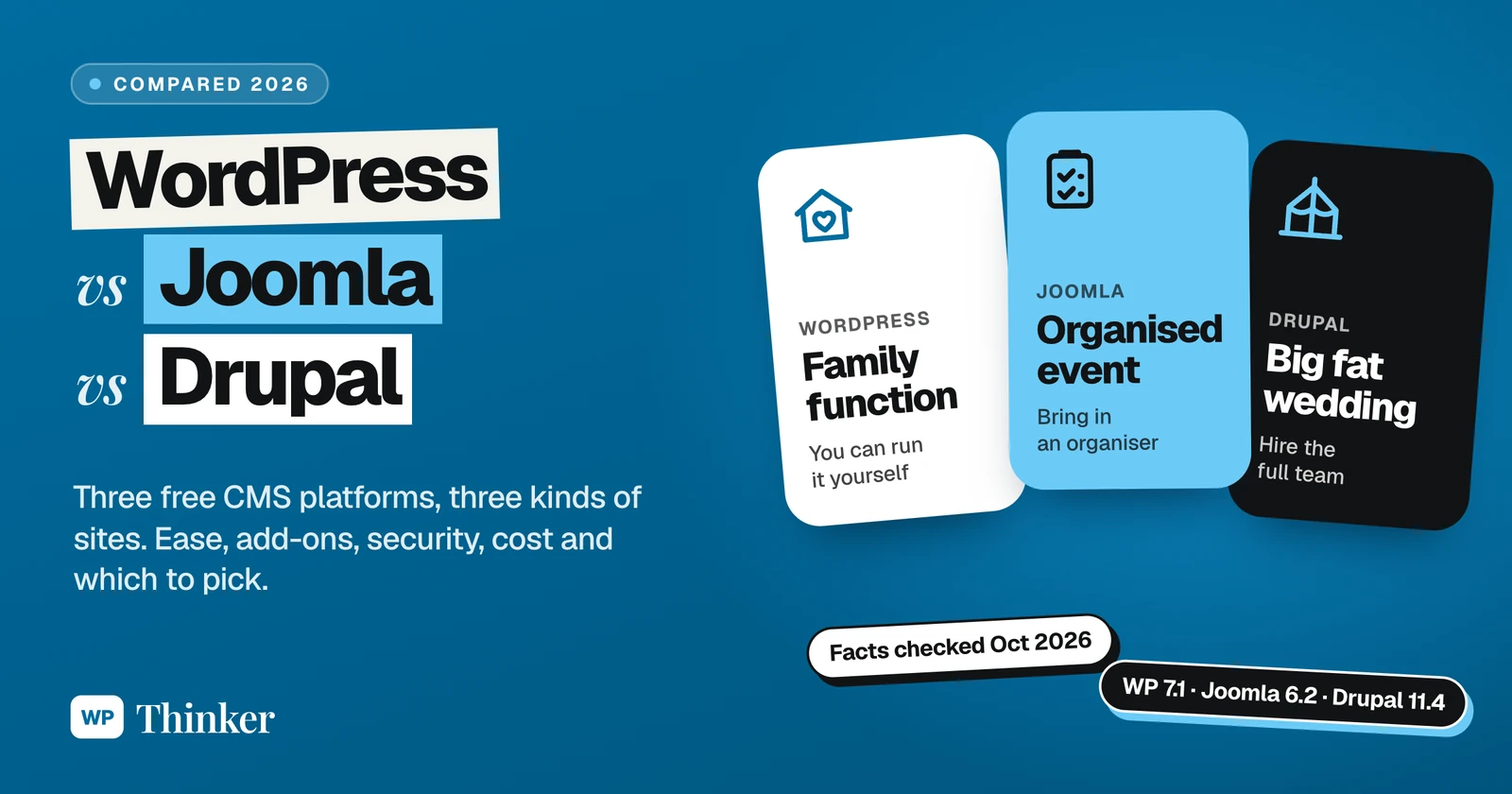
WordPress is the family function you can manage yourself. One call to the caterer, one to the decorator, one to your photographer friend, and done. Need one more thing? There's always somebody nearby who does it, and plugins work exactly like that.
Joomla is the function where you want a proper organiser. Guests are coming from three states and speak four languages, and different relatives get different kinds of access backstage. Joomla handles that well out of the box, but someone has to know its ways.
Drupal is the big fat wedding. Two thousand guests, three days, five venues, everything connected. You don't plan that with your cousin. You hire an event management company, and in Drupal's case that means developers. Get the team right, though, and it carries any amount of load.
Hold on to that picture. It answers most of the questions below.
WordPress vs Joomla vs Drupal in 2026: The Numbers
Coming to the facts. This is how the three looked on 27 October 2026:
| WordPress | Joomla | Drupal | |
|---|---|---|---|
| Share of all websites | 39.6% | 1.1% | 0.6% |
| Share among CMS sites | 58.3% | 1.6% | 0.9% |
| Latest version | WordPress 7.1 | Joomla 6.2 (13 October 2026) | Drupal 11.4, with Drupal 12 in beta |
| Add-ons in the official directory | 72,829 plugins, 8,784 themes | 5,019 extensions | 56,721 modules |
The usage figures come from W3Techs. The add-on numbers come straight from the Joomla Extensions Directory and Drupal.org's module listing. One catch with Drupal's figure, though: it also counts modules made for older Drupal versions, so plenty of them won't run on Drupal 11.
One small thing caught my eye. Joomla's own features page still says it runs "over 3% of the entire web". W3Techs puts it at 1.1% today, so that line is probably from an older year. Nothing wrong with Joomla because of it. Just take every platform's marketing with a pinch of salt. Ours too, honestly!
Which One Can You Actually Learn Quickly?
WordPress, and comfortably so. One click from your host and it's installed; give it one evening and the dashboard won't feel strange any more. Writing a post? About as tough as typing a Google Doc. (Our install guide takes you all the way from zero to a live site.)
Joomla is somewhere in between. There are more menus, more settings, and new ideas like modules, components and menu items that take a while to sink in. Once they do, it all fits together nicely. Day one, though, it's less forgiving.
Drupal has always been the hardest of the three, built for developers first. To be fair, it's working on that. Drupal CMS 2.0, the ready-made edition aimed at marketers, now offers visual page building with Drupal Canvas, site templates that install in under three minutes and optional AI tools, according to Drupal's own page. That's a real step forward. Still, once you go past the templates, you're back in Drupal's world of content types, fields and views.
Themes, Plugins and Extensions
This is where WordPress runs away with the match. Its official directory had 72,829 free plugins and 8,784 free themes when I checked. Then there's a huge premium market on top: page builders, SEO tools like Yoast SEO, booking systems, membership tools, the lot. Honestly, if you can imagine a feature, someone has probably built a plugin for it already.
Over on Joomla's side, the directory showed 5,019 extensions. That's far fewer, but many of them are mature and well kept, covering the usual needs like forms, galleries, shops and SEO.
Drupal's 56,721 sounds massive, right? But that figure stretches across many Drupal versions. And Drupal modules are more like Lego pieces for developers than features you just switch on. Powerful? Absolutely. Plug-and-play? Not always.
Many Languages, Many Editors
This is Joomla's home ground. Languages are part of the core here, and user groups with very precise access come built in too. Picture a site in English, Hindi and Telugu, where each editor may only touch their own corner. Joomla handles that without a single extra add-on.
Drupal is just as strong here, arguably stronger. Translation and detailed roles and permissions are core strengths. That makes it a natural fit for big sites where many teams edit different sections.
WordPress can do both too, but through plugins. Multilingual plugins and role-editor plugins do the job well. It just isn't in the box by default.
Security: Is Drupal Really Safer?
You'll often hear "Drupal is the most secure, WordPress is the least". I'd say that's only half true.
All three have dedicated security teams and release security fixes regularly. Take Joomla: about two weeks before 6.2 came out, it pushed security fixes for both its 6.x and 5.x versions. Why does WordPress get attacked more, then? Simple. It runs way more websites, so it's the bigger target. Dig into most hacked WordPress sites and you'll usually find an outdated or poorly made plugin at the root, not WordPress itself.
Whatever you pick, the safety drill stays the same: updates for the core and add-ons, decent hosting, regular backups, and no abandoned add-ons. On WordPress, a good security plugin takes care of half that list for you. Drupal's stricter, developer-led setup does leave fewer chances for a beginner to make mistakes. That's a real advantage, but it comes from the people running it as much as from the code.
Running an Online Store
If selling is your plan, WordPress with WooCommerce is the most common choice by a long way, and it's the setup several of my own stores run on. Payment gateways, shipping, subscriptions, bookings: there's an extension for nearly everything.
Joomla has its own shop extensions, such as HikaShop and VirtueMart, which suit smaller catalogues well. Drupal has Drupal Commerce, which is flexible and powerful for custom selling setups, but you'll want a developer for it. For a typical small or mid-size store, I'd say WordPress gets you selling the fastest.
SEO: Can All Three Rank on Google?
Yes, all three can. Google ranks useful pages, not platforms.
The real gap is in hand-holding. WordPress has SEO plugins that live inside the editor and keep reminding you about titles, meta descriptions, schema and sitemaps as you type. Joomla comes with decent basics of its own, like clean URLs and metadata fields, and there are SEO extensions if you want more. Drupal's SEO modules are capable, but usually need someone to set them up properly.
What Does Each One Really Cost?
All three are free to download, and all three run on the same kind of PHP hosting. You can compare real hosting costs, renewals included, in our hosting comparison.
The real cost difference is people. Need a WordPress developer? You'll find one in your own city, at almost any budget. With Joomla, that list gets shorter. Drupal work is specialised, and specialists usually cost more. For a big organisation, that's a fair trade. For a small business, it can quietly double your running costs.
Can You Switch From Joomla or Drupal to WordPress?
Yes, and there are maintained tools for it. On WordPress.org, FG Joomla to WordPress had over 6,000 active installs and an update on 2 October 2026. FG Drupal to WordPress was updated on 25 September 2026. Both move posts, pages, categories and images across.
My advice: test the move on a staging copy first, check your URLs and set up redirects for any that change, so Google and your readers follow you to the new site.
So, Which CMS Is Right for You?
Go with WordPress if:
- you're building a blog, a business website or an online store;
- you want to manage things yourself, without a developer on call;
- you'd like the widest choice of themes, plugins and people to hire.
Go with Joomla if:
- multilingual content and detailed user access matter from day one;
- you're comfortable spending some time learning how it's put together;
- a smaller but steady extension library covers your needs.
Go with Drupal if:
- your site is big and complex, with many content types, workflows and integrations;
- you have developers, in-house or an agency, to build and look after it;
- scale and tight control matter more to you than ease of use.
For most people reading WP Thinker, my honest pick is WordPress. Not because Joomla or Drupal are bad, mind you. WordPress just gets most sites live faster, and keeps the running costs lower year after year. Weighing hosted builders as well? See how WordPress compares with Wix, or read up on WordPress.com vs WordPress.org first.
Your Questions About WordPress vs Joomla vs Drupal
Which is best for a small business website?
WordPress, for most small businesses. Setup is quick, your staff can update it without much training, and there's a plugin for nearly every need. Get stuck somewhere? Someone who knows WordPress is rarely far away.
Does Joomla still make sense in 2026?
Yes, for the right project. Joomla 6.2 came out on 13 October 2026, so it's actively developed, and its built-in multilingual and access control features are genuinely good. It's just a smaller world than WordPress, with fewer extensions and fewer developers.
Is Drupal really safer than WordPress?
Not automatically. Both have strong security teams. Drupal sites are usually built and run by developers, which avoids many beginner mistakes. A well-kept WordPress site with updated plugins can be very secure too.
Which one is best for a large enterprise website?
Drupal is often the first choice for very complex sites with many content types, workflows and integrations, if you have a development team. That said, plenty of big sites run on WordPress too. It really comes down to how complicated your content is.
I'm on Joomla now. Can I move to WordPress?
Sure. The FG Joomla to WordPress plugin carries over posts, pages, categories and images, and it's still being updated. Do a trial run on a staging site first, and redirect any URLs that change.
Will I have to learn coding?
Not for WordPress, and not much for basic Joomla sites. Drupal is where coding knowledge really pays off. Drupal CMS 2.0 lowers the bar with site templates and visual page building, though.
Summing Up
So, WordPress vs Joomla vs Drupal? WordPress is the family function you can manage yourself. Joomla is the well-organised event with guests from everywhere. Drupal is the big fat wedding that needs a professional team. All three are free and capable. So match the platform to the size of your celebration, and to the team you've actually got.
That's all for now. Family function, organised event or big fat wedding, which one is your website? Do let us know in the comment box below.