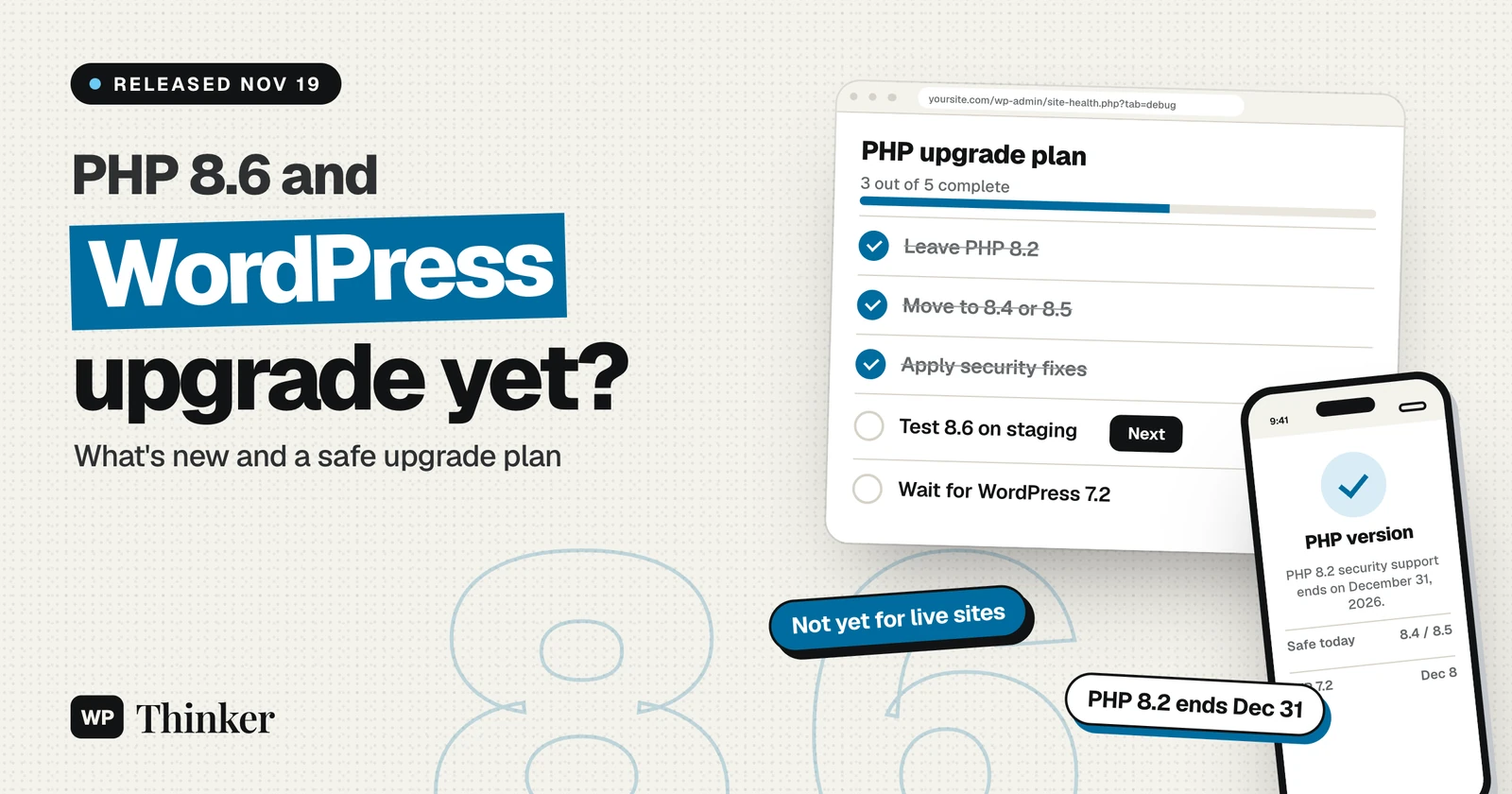
PHP 8.6 was released on November 19, 2026, and some hosts will add it to their control panels within days. If you run WordPress, the big question is simple: should you switch? Our short answer is not yet for a live site, but there are two PHP tasks you should handle this month. Below we cover what's new in PHP 8.6, where WordPress stands, and a safe upgrade plan.
The first weeks after a big PHP release are when plugin errors tend to show up. A little patience saves a lot of trouble.
When Was PHP 8.6 Released?
The PHP team released PHP 8.6.0 on November 19, 2026, right on the date in the PHP 8.6 release schedule. It took more release candidates than usual, including an extra RC7 on November 12, but the date held.
On the same day, the PHP team shipped security releases for every supported version: PHP 8.5.13, 8.4.28, 8.3.37 and 8.2.36. According to the PHP changelog, the fixes include a use-after-free bug that could lead to remote code execution (CVE-2026-129474) and a memory bug in PHP-CGI (CVE-2026-129538). The PHP security team rated the worst issues critical, but said they need a non-default configuration or an uncommon setup. Either way, make sure your host installs these updates.
What's New in PHP 8.6
The official release announcement calls PHP 8.6 a major update to the language. Most of the new features help developers rather than site owners, but they're worth knowing about:
- Partial function application. You can fill in some of a function's arguments ahead of time, using
?and...placeholders, and get back a closure that takes the rest. - A new
\Time\Durationclass. It stores elapsed time, like a timeout or a benchmark, with nanosecond precision. - A polling API. Event-loop libraries such as ReactPHP and AMPHP can watch many network streams at once using the operating system's own tools.
- A new
clamp()function. It keeps a value inside a range, replacing the usualmin()andmax()combination. - A
SortDirectionenum. A built-in, shared way to say ascending or descending. - Defaults for readonly properties. Readonly properties can now declare a default value instead of setting it in the constructor.
- Clearer errors. JSON error messages now show where the problem is, and stream functions can be set to throw exceptions instead of warnings.
The PHP team also lists speed work, including faster printf() calls and faster JSON encoding. Any real gain on a WordPress site depends on your plugins and theme, so measure before and after rather than expecting a big jump.
Deprecations That Could Affect WordPress Plugins
This is the part we'd pay the most attention to. PHP 8.6 deprecates a long list of older functions and habits. A deprecation doesn't break your site on its own. It adds a notice to the error log, and the feature will be removed in a later version. These are the ones most likely to turn up in older plugins and themes:
- The
is_integer(),is_long(),is_double()anddoubleval()aliases. Code should useis_int(),is_float()andfloatval()instead. spl_object_hash(), which is replaced byspl_object_id().- The mbstring regular expression functions, such as
mb_ereg()andmb_split(). - Passing a third argument to
define(), and usingreturninside afinallyblock.
Two other changes can matter more. PHP sessions are now more secure by default, with strict mode, HttpOnly cookies and SameSite=Lax turned on. WordPress core doesn't rely on PHP sessions, but some form, membership and older cart plugins do. Also, many functions now throw a ValueError for invalid values instead of quietly ignoring them, which can stop a badly written plugin with a fatal error. The PHP 8.6 migration guide has the full list.
Does WordPress Support PHP 8.6?
Not officially yet. The WordPress PHP compatibility table lists PHP 7.4 through 8.5 for WordPress 7.0 and 7.1, and it doesn't include 8.6 so far. WordPress 7.0 also dropped support for PHP 7.2 and 7.3.
The good news is that WordPress 7.2 is being prepared for it. The WordPress 7.2 Beta 5 announcement said all known PHP 8.6 compatibility issues had been fixed in core, and the Release Candidate 1 post lists PHP 8.6 compatibility improvements among its highlights. WordPress 7.2 is due on December 8, so that's the first version we'd pair with PHP 8.6. Our WordPress 7.2 guide covers what else is coming.
Keep in mind that WordPress core is only part of the picture. Your theme and every active plugin also need to work on PHP 8.6, and many plugin authors only start testing once a version is final.
PHP Support Dates: Why 8.2 Users Should Move Now
This is the part that matters more than PHP 8.6 for most site owners. Each PHP version gets two years of active support, then two more years of security fixes only. Here are the current dates from php.net.
| PHP version | Released | Active support until | Security fixes until |
|---|---|---|---|
| 8.2 | December 8, 2022 | December 31, 2024 | December 31, 2026 |
| 8.3 | November 23, 2023 | December 31, 2025 | December 31, 2027 |
| 8.4 | November 21, 2024 | December 31, 2026 | December 31, 2028 |
| 8.5 | November 20, 2025 | December 31, 2027 | December 31, 2029 |
| 8.6 | November 19, 2026 | Not yet listed on php.net | |
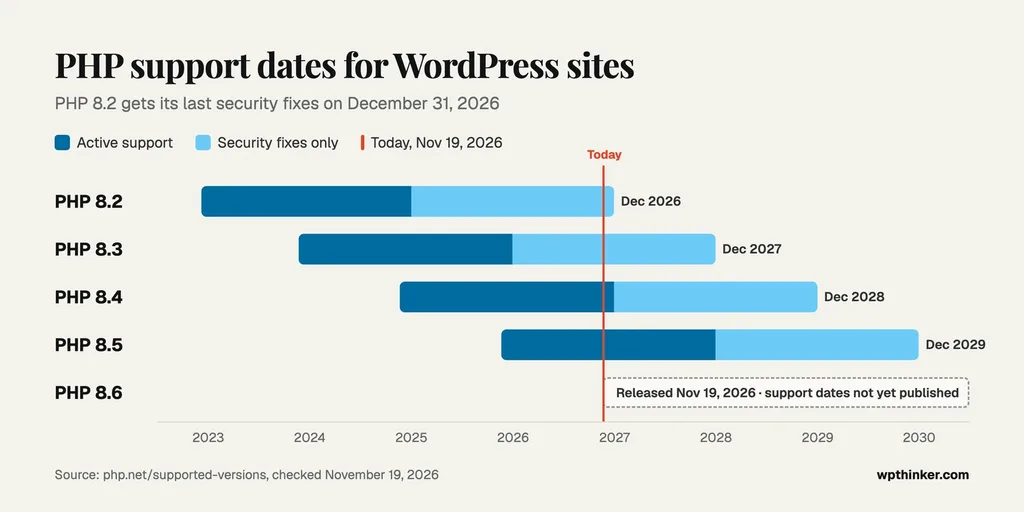
PHP 8.2 stops receiving security fixes on December 31, 2026, just six weeks from now. After that, any new PHP vulnerability will stay open on servers that still run 8.2. In October, the PHP team released fixes for two critical remote code execution flaws, so this isn't a theoretical risk. If your site still runs PHP 8.2 or older, moving to 8.4 or 8.5 is the upgrade to do this month, not 8.6.
Should You Upgrade Your WordPress Site to PHP 8.6?
Here's how we'd decide, based on the version you're on today. If you're not sure, our guide on how to check your PHP version in WordPress shows where to find it under Tools → Site Health.
- On PHP 8.2 or older: Upgrade to PHP 8.4 or 8.5 now. Both are supported by WordPress 7.0 and 7.1 and receive security fixes for years.
- On PHP 8.3, 8.4 or 8.5: You're fine for now. Make sure your host has installed the November 19 security releases (8.5.13, 8.4.28 or 8.3.37), then wait before moving to PHP 8.6.
- Developers and agencies: Start testing PHP 8.6 on a staging site today, so your plugins and themes are ready when clients ask.
For live sites, we recommend waiting until WordPress 7.2 is out and your main plugins have confirmed PHP 8.6 support, which usually means early 2027. A store doesn't gain enough from a brand-new PHP version to risk errors during the holiday season.
How to Test PHP 8.6 Safely
When you're ready, follow these steps so a problem never reaches your visitors.
- Back up the site. Take a full backup of files and the database.
- Create a staging copy. Most hosts offer one-click staging, or see our WordPress staging guide.
- Update everything first. Update WordPress, your theme and every plugin on staging before you change PHP.
- Switch staging to PHP 8.6. Your host's control panel usually has a PHP version selector.
- Test the important pages. Check the home page, a few posts, forms, search and, for stores, a full test order.
- Check the error log. Look for warnings and deprecation notices, and report them to the plugin authors.
If something breaks, switch staging back to the previous PHP version. Our step-by-step guide on how to update PHP in WordPress covers the control panel settings for the most common hosts.
Also This Week: WordPress 7.1.5
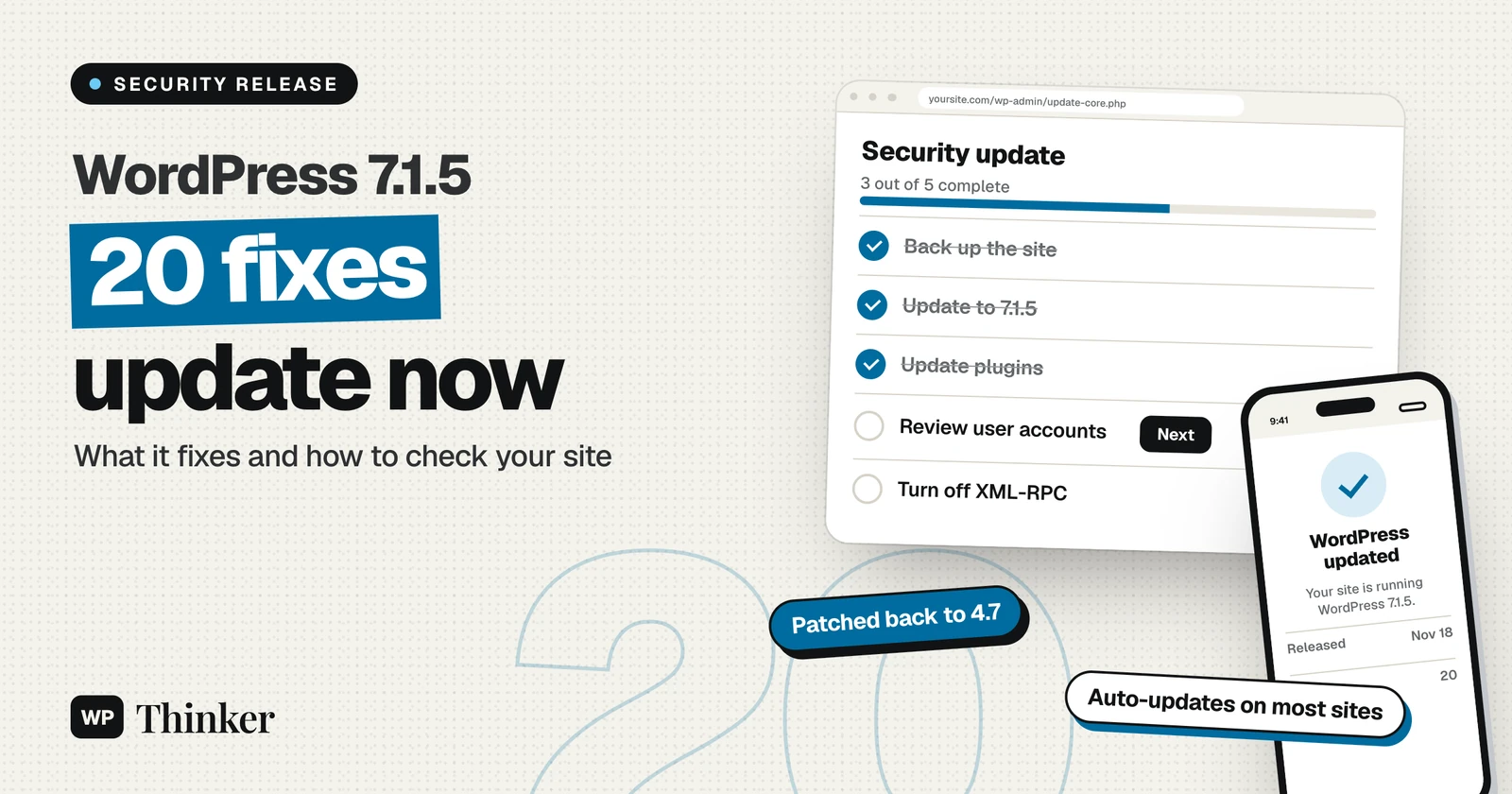
While you're thinking about updates, WordPress itself released version 7.1.5 on November 18. It's a security release with 20 fixes, including cross-site scripting and SQL injection issues, and WordPress recommends updating immediately. Our WordPress 7.1.5 guide explains each one. Most sites will get it automatically, but check Dashboard → Updates to be sure.
PHP 8.6 FAQs
When was PHP 8.6 released?
PHP 8.6.0 was released on November 19, 2026, on the date set in the official PHP release schedule.
Is WordPress compatible with PHP 8.6?
Not officially yet. WordPress 7.2, due December 8, 2026, includes PHP 8.6 compatibility fixes. Plugins and themes also need to support it before you switch a live site.
Which PHP version should I use for WordPress right now?
PHP 8.4 or 8.5 is the safest choice today. Both are officially supported by WordPress 7.1 and will receive security fixes until 2028 and 2029.
What happens when PHP 8.2 reaches end of life?
After December 31, 2026, PHP 8.2 gets no more security fixes. Your site will keep working, but new vulnerabilities won't be patched, so you should upgrade before then.
Final Thoughts
PHP 8.6 is a big release for developers, but there's no rush to put it on a live WordPress site. Wait for WordPress 7.2 and your plugins to catch up, and test on staging first. The more urgent job is moving off PHP 8.2 before its security support ends on December 31. We'll update this post when php.net adds the support dates for PHP 8.6.