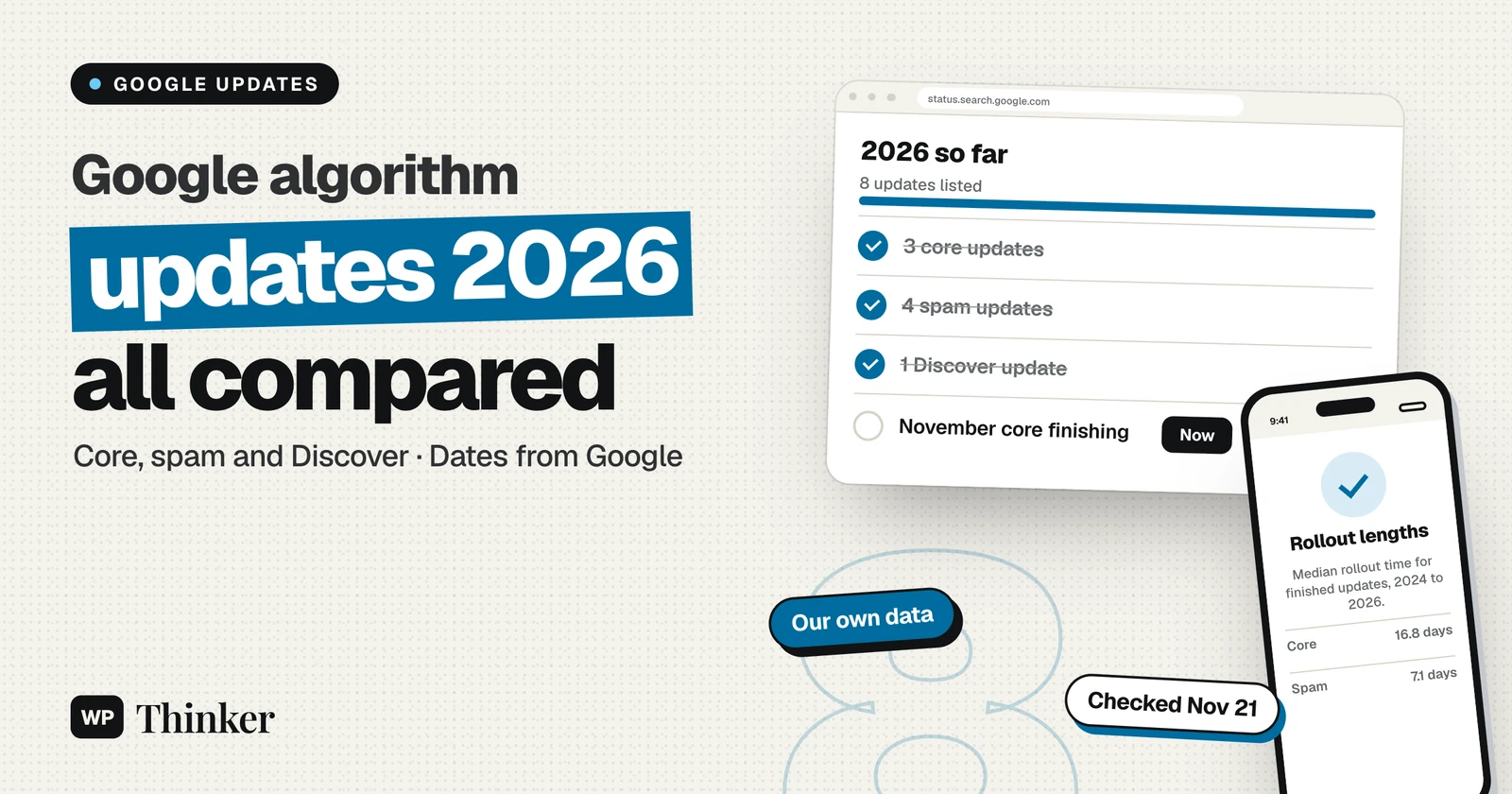
Google has confirmed eight ranking updates so far in 2026: three core updates, four spam updates and one Discover update. That is the full list of Google algorithm updates 2026 on the Google Search Status Dashboard, which we checked on November 21, 2026. Below, we compare every one by date and rollout length, and show how to match a traffic drop on your WordPress site to the right update.
There was no new ranking announcement in the past week, and the November 2026 core update, which started on November 10, is still rolling out. That makes this a sensible moment to review the whole year and plan your checks.
Google algorithm updates 2026: every one compared
This table comes straight from the dashboard's Ranking history. The start dates and durations are Google's own, and we took the end dates from the dashboard's public data feed.
| Update | Type | Started | Rollout complete | Duration |
|---|---|---|---|---|
| February 2026 Discover update | Discover | Feb 5 | Feb 27 | 21 days, 17 hours |
| March 2026 spam update | Spam | Mar 24 | Mar 25 | 19 hours, 30 minutes |
| March 2026 core update | Core | Mar 27 | Apr 8 | 12 days, 4 hours |
| May 2026 core update | Core | May 21 | Jun 2 | 11 days, 21 hours |
| June 2026 spam update | Spam | Jun 24 | Jun 26 | 2 days, 1 hour |
| August 2026 spam update | Spam | Aug 18 | Aug 21 | 2 days, 16 hours |
| September 2026 spam update | Spam | Sep 24 | Oct 8 | 13 days, 16 hours |
| November 2026 core update | Core | Nov 10 | Still rolling out | Day 11 on Nov 21 |
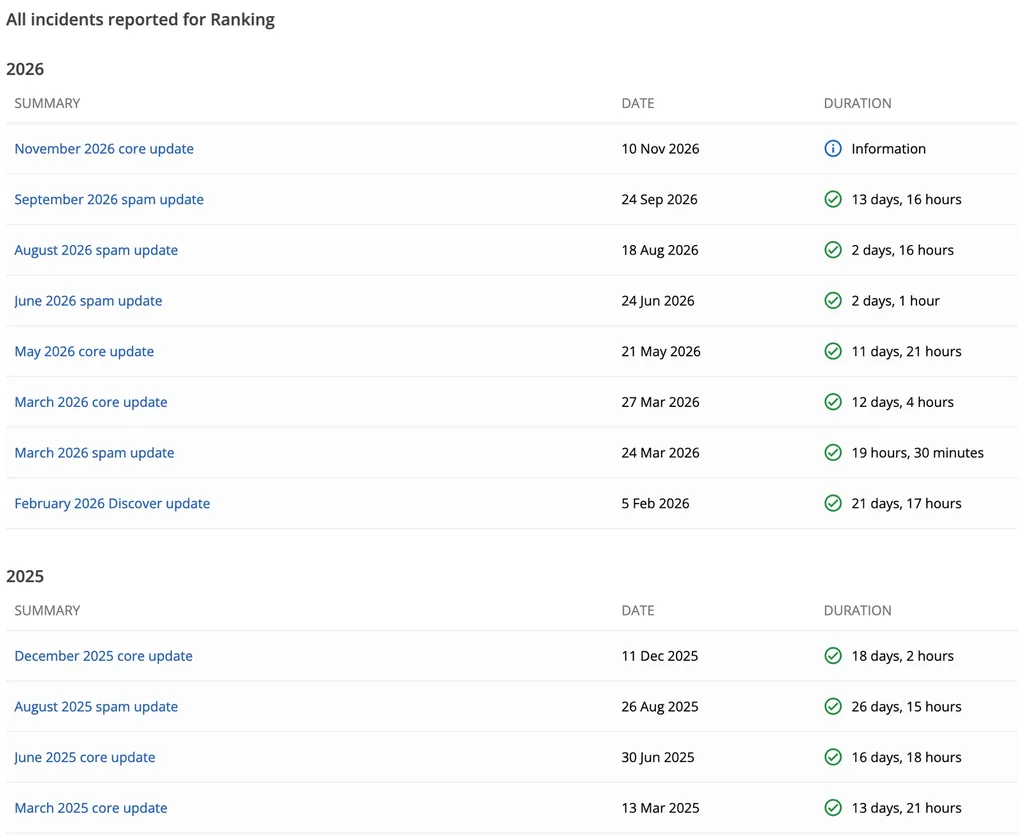
Two patterns stand out. First, spam updates came more often than core updates this year, four against three. Second, the gaps between core updates were uneven. There were 106 days between the December 2025 and March 2026 core updates, 55 days to May, and then 173 days to November. Nobody can predict the next one from that pattern, so don't plan your content around a guess.
How long rollouts take: three years of data
We went back to 2024 to get a bigger sample. That gives nine finished core updates and eight finished spam updates on the dashboard.
| Measure | Core updates | Spam updates |
|---|---|---|
| Finished updates, 2024 to 2026 | 9 | 8 |
| Median rollout | 16.8 days | 7.1 days |
| Average rollout | 18.5 days | 9.4 days |
| Shortest | 6.2 days (Dec 2024) | 0.8 days (Mar 2026) |
| Longest | 45 days (Mar 2024) | 26.6 days (Aug 2025) |
| Median, 2025 and 2026 only | 13.9 days | 2.7 days |
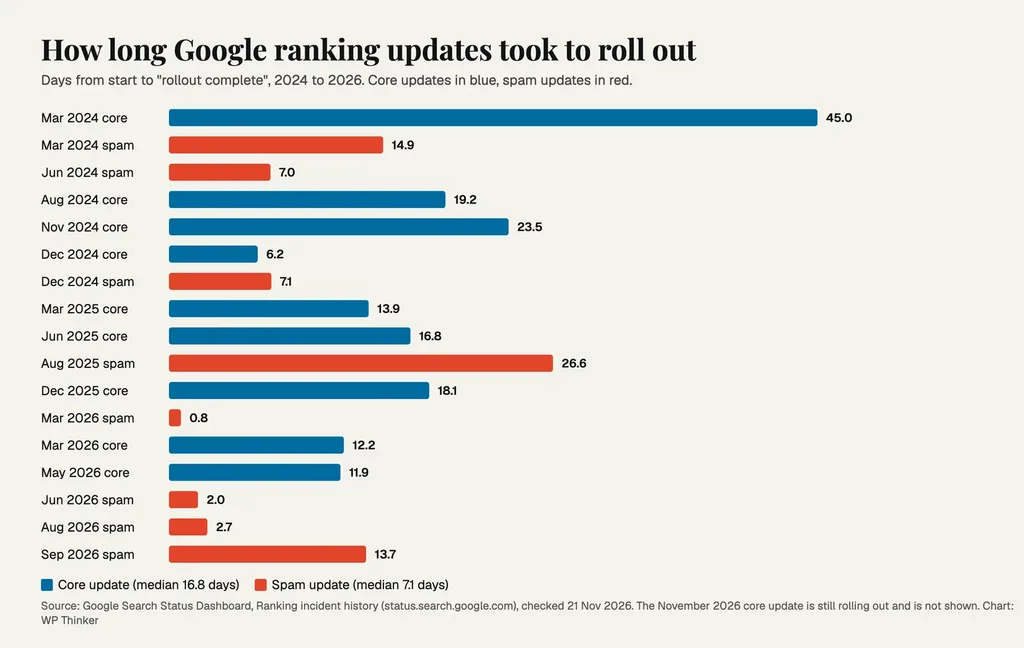
Core updates have become shorter and more consistent. The five since 2025 all finished in 11.9 to 18.1 days. Spam updates are less predictable: three of the four in 2026 ended in under three days, but September's took almost two weeks.
For the November 2026 core update, Google's notice says the rollout "may take up to 2 weeks". The recent record agrees. If it follows the 2025 to 2026 pattern, expect it to finish in the last week of November. Treat that as an estimate, not a fact, until the dashboard says it's done.
Core updates vs spam updates: what each one means
The two kinds of update ask different things of you, so it matters which one affected your site.
- Core updates are broad changes to Google's ranking systems. In its core updates guide, Google says they don't target specific sites or pages. A drop doesn't mean your site broke a rule. Other pages may simply be doing a better job for searchers.
- Spam updates are improvements to systems such as SpamBrain. Google's spam updates page says sites that break its spam policies may rank lower or drop out of results. The fix is to follow the policies. Recovery can take months.
- Link spam is a special case. Google says the lost benefit from spammy links can't be regained, even after you clean up.
- The Discover update in February only affected Google Discover. If your Search traffic held steady but Discover fell, that's the place to look.
| Core update | Spam update | |
|---|---|---|
| Strength | Not a penalty, so good pages often recover in later updates | Clear rules to check against |
| Weakness | No single thing to fix | Recovery is slow, and link gains are gone for good |
| First step | Wait a week after it ends, then compare | Read the spam policies and audit the site |
Worked example: matching a drop to the right update
Google's advice is to wait at least a full week after a core update finishes. Then compare the week after with a week before it started. Here is how that works for the May 2026 core update.
- Find the dates. The update started on May 21 and finished on June 2.
- Wait a week. Start your "after" window on June 9.
- Pick two equal windows. Compare June 9 to 15 with May 14 to 20. Both are seven days, and both start on the same weekday.
- Check for overlap. The June 2026 spam update began on June 24, so it falls outside both windows. Your result reflects the core update alone.
- Open Search Console. In the Performance report, use the Date filter's compare option and enter both custom ranges. Look at the Pages and Queries tabs.
- Judge the size. Google calls a fall from position 2 to 4 small, and from 4 to 29 large. Only large, site-wide drops need a deep review.
You can also pull the dates yourself. The dashboard has a public JSON feed. We ran this command on November 21, and it printed every ranking update with its start and end dates:
curl -s https://status.search.google.com/incidents.json | python3 -c "import json,sys
for i in json.load(sys.stdin):
    if i['service_name'] == 'Ranking':
        print(i['begin'][:10], (i.get('end') or 'ongoing')[:10], i['external_desc'])"
The top line read "2026-11-10 ongoing November 2026 core update". If you track your rankings in a spreadsheet, paste these dates in as markers. Our guide to the Search Analytics API shows how to pull your own Search Console data the same way.
Common mistakes we found in the data
- Blaming the wrong update. In March, a spam update ran on March 24 and 25. A core update began two days later. A drop on March 25 points to spam. A drop in early April points to the core update.
- Treating every entry as an update. The dashboard also lists incidents. On August 15, 2024, a "Ranking is experiencing an ongoing issue" entry began on the same day as the August 2024 core update. A serving bug can look like a ranking change.
- Checking too early. Rankings fluctuate throughout a rollout, so comparing on day five of a 12-day update tells you very little.
- Rewriting pages that still rank well. Google advises against big changes to content that's already doing well. A small slip is normal.
- Missing a technical cause. Google's traffic drop guide lists site errors, a stray noindex tag and data glitches as other causes. Check the Page indexing and Crawl stats reports before blaming the algorithm.
What WordPress site owners should do now
While the November core update finishes, keep your routine normal: publish as planned, and leave your best-performing posts alone. After the dashboard says it's done, wait seven days, then run the comparison above.
Some WordPress chores help whatever the update. Make sure your SEO plugin isn't adding a noindex tag to pages you want ranked. Our list of the best SEO plugins for WordPress covers where that setting lives. If a spam update hits you hard, scan for injected spam pages too. Hacked WordPress sites often get hidden pages that break Google's policies, and our hacked site guide explains how to find them. For the current update in detail, see our November 2026 core update guide.
FAQs
How many Google algorithm updates were there in 2026?
Google listed eight ranking updates on its dashboard by November 21, 2026: core updates in March, May and November, spam updates in March, June, August and September, and a Discover update in February.
Does Google announce every algorithm change?
No. Google says it makes smaller core updates that aren't announced because they aren't widely noticed. The dashboard only lists the notable ones.
Can I recover before the next core update?
Possibly. Google says some changes take effect in days, but it can take months for its systems to judge a site as a whole. Unannounced smaller updates can also lift improved pages.
How long should I wait before checking Search Console?
Google recommends waiting at least a full week after a core update finishes. Then compare that week with a week before the update started.
How we checked
We read the Ranking history on the Search Status Dashboard and its JSON feed on November 21, 2026, and took the screenshot above the same day. We worked out the medians and averages ourselves from Google's stated durations. Every statement about how updates work comes from Google's own Search Central pages, listed below. We didn't test any update on a live site, as no single site can isolate one.
Our verdict
For a small blog, the best move is patience: wait for the November rollout to end plus a week, and only act on large, site-wide drops. For store owners and busy news sites, mark every update date on your traffic reports so you can tell a core drop from a spam drop at a glance. For agencies and SEO teams, use the JSON feed to pull dates into your dashboards. Whichever group you're in, check the dashboard first when tracking Google algorithm updates 2026, before you change a single page.
Sources for Google algorithm updates 2026
- Google Search Status Dashboard, Ranking history (checked November 21, 2026)
- Google Search Status Dashboard incidents feed (checked November 21, 2026)
- Google Search's core updates and your website, Google Search Central (checked November 21, 2026)
- Google Search spam updates and your site, Google Search Central (checked November 21, 2026)
- Debugging drops in Google Search traffic, Google Search Central (checked November 21, 2026)
All dates in this guide to Google algorithm updates 2026 follow the UTC timestamps in Google's dashboard feed.