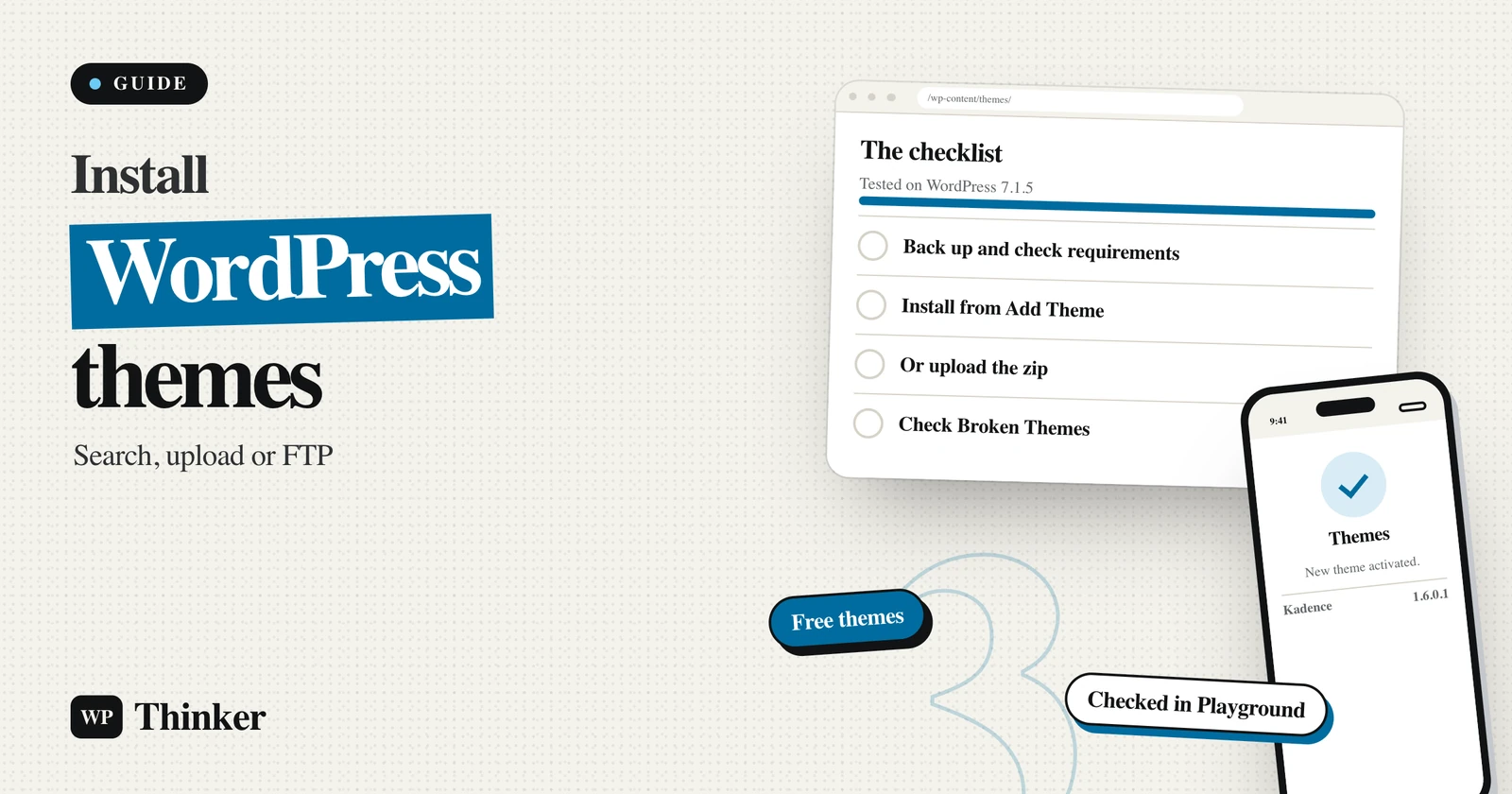
Want a new look for your site but not sure where the theme files are supposed to go? You can install WordPress themes in three ways: search the theme directory from your dashboard, upload a theme zip with the Upload Theme button, or copy the unzipped theme folder to wp-content/themes over FTP. All three end the same way, with one click on Activate under Appearance → Themes.
In plain terms: a theme is a folder of files that controls how your site looks. WordPress scans the themes folder and lists every complete theme it finds there. Installing a theme just means getting that folder onto your server in the right shape. Activating it is a separate step, and only one theme can be active at a time.
We ran all three methods on a fresh WordPress 7.1.5 site in WordPress Playground on November 21, 2026, and noted where things went wrong.
Which method should you use?
Start with the first method that fits your situation. The dashboard is the safest because WordPress unpacks the files for you.
| Method | Best for | What you need |
|---|---|---|
| 1. Search from the dashboard | Free themes listed on WordPress.org | An admin account |
| 2. Upload a zip | Themes you downloaded or bought elsewhere | The theme's .zip file |
| 3. FTP or File Manager | Uploads that fail, or no wp-admin access | FTP/SFTP login or your host's File Manager |
The official directory at WordPress.org/themes held 8,888 themes when we checked the WordPress.org theme API on November 21, 2026. The WordPress.org manual says every theme there is reviewed by a dedicated team against a set of required rules. That review is a good reason to start there.
What should you check before you install WordPress themes?
- Back up your site. Installing a theme is harmless, but activating one changes how every page looks. Classic themes can also drop widgets and menus from places the new theme doesn't support.
- Check the requirements. Each theme page lists the minimum WordPress and PHP versions. Our example theme, Kadence, needs WordPress 6.6 and PHP 7.4 or newer (version 1.6.0.1, updated November 20, 2026, with 500,000+ active installs, per the theme API).
- Look at "last updated". A theme that hasn't been touched in years may not work well with the current editor.
- Skip "free" copies of paid themes. Nulled themes from file-sharing sites often hide malware. We explain why in the problems with nulled themes and plugins.
- Know if it's a block theme or a classic theme. Block themes are edited in Appearance → Editor. Classic themes use Customize, Widgets and Menus. Use the Block Themes tab in the directory if you want the first kind.
Method 1: How do you install a theme from the dashboard?
This is the fastest route for any theme listed in the official WordPress.org directory, because WordPress downloads, verifies and unpacks the package automatically.
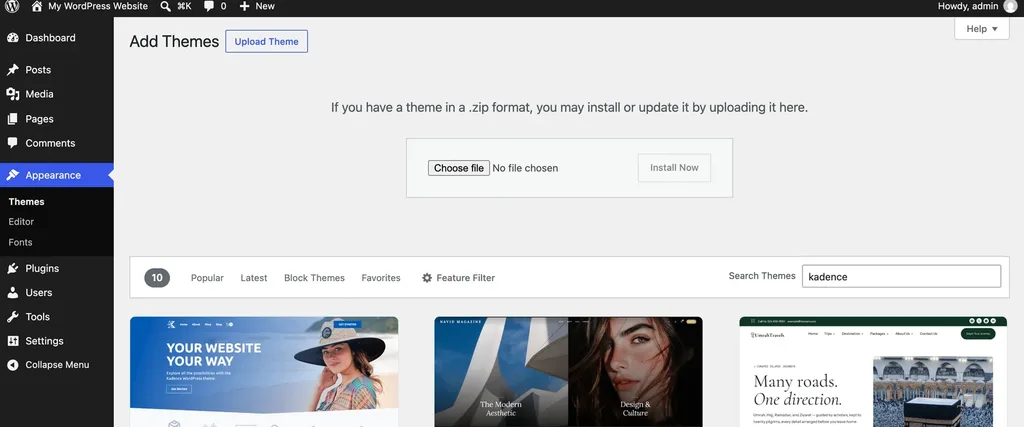
- Go to Appearance → Themes.
- Click Add Theme at the top. (Older guides, and even parts of the WordPress.org manual, still call this button "Add New".)
- Browse the Popular, Latest or Block Themes tabs, use Feature Filter, or type a name into Search Themes.
- Hover over a theme and click Details & Preview to see a demo, or click Install.
- Wait for the button to change to Installed!, then activate the theme (see below).
In our test we searched for "kadence" and clicked Install. The 2.2 MB theme downloaded and unpacked in about 3 to 5 seconds across two runs.
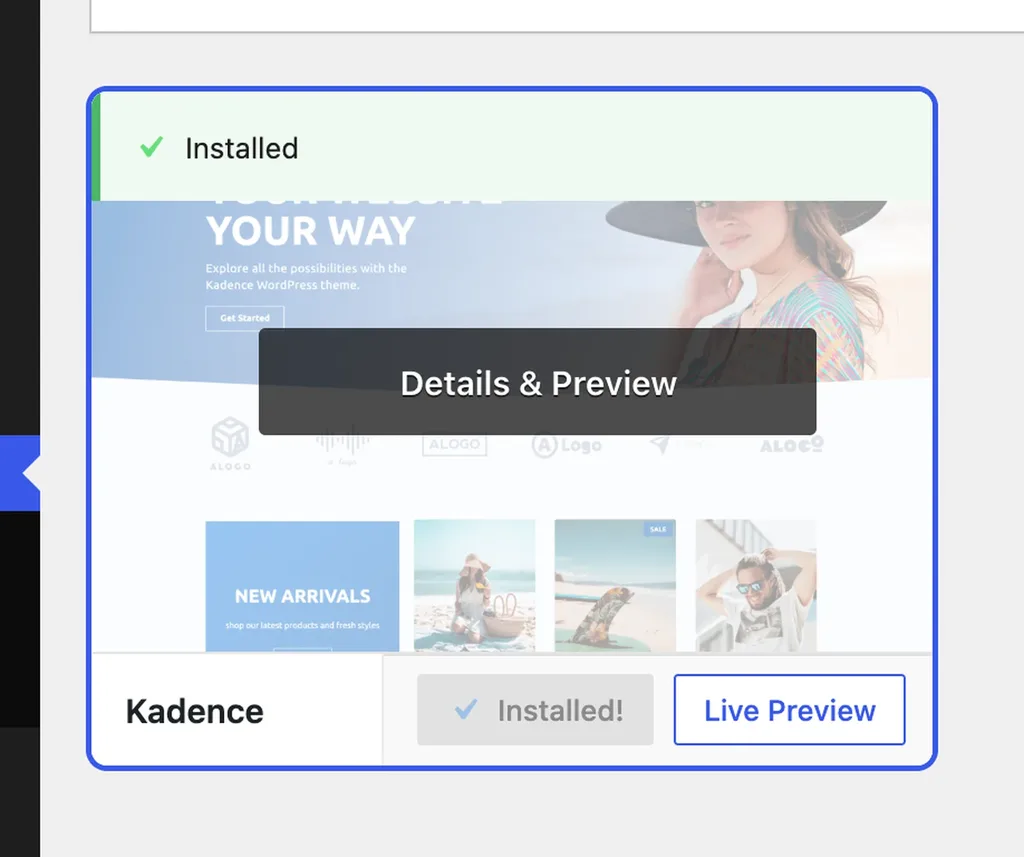
One thing confused us. On our test site the card showed only Installed! and Live Preview, with no visible Activate button. If that happens to you, go back to Appearance → Themes and activate it there.
Method 2: How do you upload a theme zip file?
Use this method for premium themes purchased from a commercial theme shop, for custom themes delivered by a developer, or for any theme you previously downloaded.
- Go to Appearance → Themes → Add Theme.
- Click Upload Theme at the top of the screen.
- Click Choose file and pick the theme's .zip file. Don't unzip it first.
- Click Install Now.
- When WordPress says the theme was installed, click Activate.
The most common error here is "The package could not be installed. The theme is missing the style.css stylesheet." It usually means you uploaded the wrong zip, such as a whole download bundle that has the real theme zip inside it. Our guide to fixing the missing style.css error walks through it. If the upload is rejected for size instead, your host's PHP upload limit is too low, so use Method 3.
Method 3: How do you install a theme with FTP or File Manager?
This manual method is useful when uploads fail because of server restrictions, or when you can't log in to wp-admin at all.
- Download the theme zip and unzip it on your computer. You should get one folder named after the theme, with
style.cssinside it. - Connect with an FTP client. SFTP is safer if your host offers it. Our guide on accessing WordPress via FTP shows where to find your login, and we compare apps in our list of FTP clients.
- Open
wp-content/themes. On many hosts it sits insidepublic_html. - Upload the whole theme folder there.
- Go to Appearance → Themes and activate it.
Your host's File Manager works too. The WordPress.org manual describes uploading the zip with cPanel's File Manager, then using its Extract option inside the themes folder. Plugins follow the same pattern, which we covered in installing a plugin via FTP.
What did our folder test show?
Manual installs fail when the folder lands in the wrong place, so we tested six layouts. Playground has no FTP server, so we created each layout by copying files into wp-content/themes on the test site, using the free Ollie theme. Then we read what WordPress listed with wp_get_themes() and checked the Themes screen.
| What was in wp-content/themes | Result on WordPress 7.1.5 |
|---|---|
ollie/style.css (normal) | Listed and working |
ollie-download/ollie/style.css (one extra folder) | Listed and working, as a second "Ollie" |
backup-folder/old-copy/ollie/style.css (two extra folders) | Broken: "Stylesheet is missing." |
A folder with index.php but no style.css | Broken: "Stylesheet is missing." |
| A child theme whose parent isn't installed | Broken: "The parent theme is missing." |
| A .zip file left unextracted | Ignored, with no warning at all |
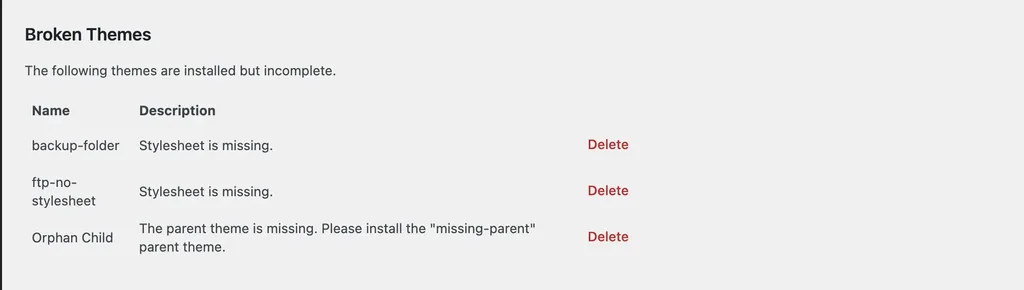
Three lessons came out of this. First, an unextracted zip simply does nothing, so if your theme doesn't appear, check that you unzipped it. Second, WordPress looks one folder deeper than you'd expect, which can leave two identical themes on the screen, as it did for us. Third, the Broken Themes list at the bottom of the Themes screen is the first place to look when a manual install fails. The Theme Handbook explains why: style.css and its header are what make a folder a theme.
How do you activate the theme once it's installed?
Go to Appearance → Themes, hover over the theme and click Activate. You can click Live Preview first to see your own content in the new design. On our site, activating Kadence showed a "New theme activated" notice.
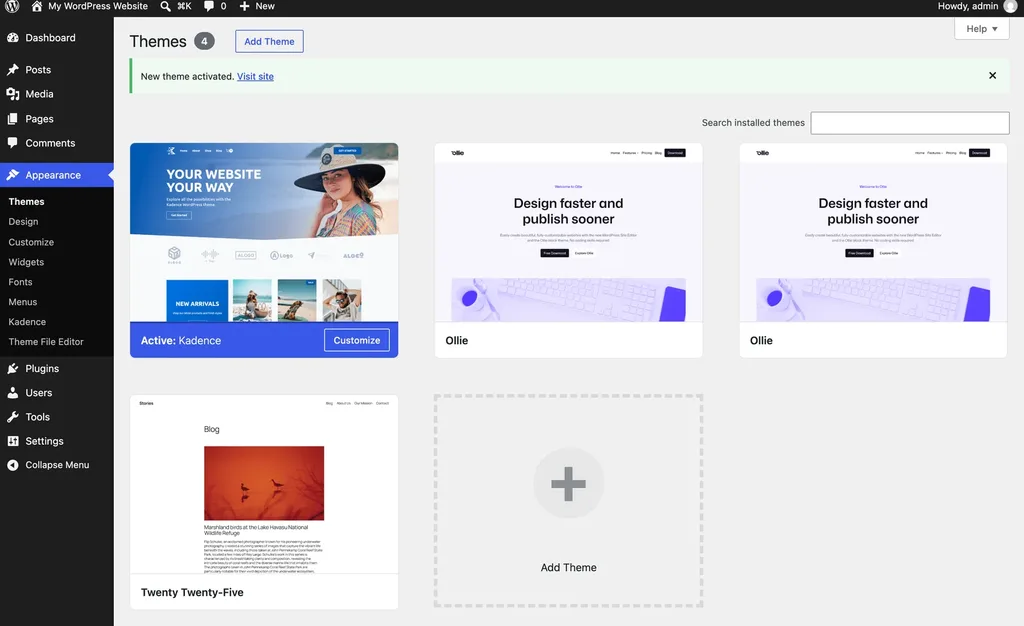
Notice how the Appearance menu changed. With the block theme Twenty Twenty-Five active, it showed Themes, Editor and Fonts. With Kadence, a classic theme, it showed Customize, Widgets, Menus and a Kadence page. Think of the theme as the frame around a painting: your posts and pages stay the same, but the frame decides which tools you get to adjust it.
If you plan to edit the theme's code, set up a child theme first so updates don't wipe your changes. See our guide to creating a child theme and the Theme Handbook's child theme page.
Frequently asked questions
Can I install more than one theme?
Yes. You can install as many themes as you like, but WordPress only allows one active theme at a time. Delete the ones you don't use, keeping one default theme as a fallback. Our guide on deleting WordPress themes shows how.
Will changing my theme delete my posts?
No. Posts, pages, media and users are stored in the database, not in the theme. Theme-specific settings, widgets and menu locations may need to be set up again.
Why is there no Add Theme button on my site?
You need an Administrator account. On a multisite network, only the Network Admin can install themes. Some hosts also turn off installs with the DISALLOW_FILE_MODS setting, explained in the wp-config.php documentation.
Do themes installed by FTP still get updates?
Yes, if the theme comes from WordPress.org and keeps its original folder name. Updates then appear under Dashboard → Updates, which we cover in updating WordPress safely.
Wrapping up
For most people, the dashboard search is the right choice: it's quick, and the theme comes from a reviewed directory. Use Upload Theme for zips from elsewhere, and keep FTP for when uploads fail or wp-admin is down. Whichever method you choose, check the Broken Themes list if anything goes missing, and activate only after you've backed up and previewed. Looking for ideas before you install WordPress themes on your own site? Start with our picks of the best WordPress themes for blogs.
Sources
- Work with Themes, WordPress.org documentation (checked Nov 21, 2026)
- Main Stylesheet (style.css), Theme Handbook (checked Nov 21, 2026)
- Child Themes, Theme Handbook (checked Nov 21, 2026)
- Theme review requirements, Themes Team handbook (checked Nov 21, 2026)
- Kadence on WordPress.org and the WordPress.org theme API (checked Nov 21, 2026)
- WordPress version check API, showing 7.1.5 as the current release (checked Nov 21, 2026)
- WP Thinker test: how to install WordPress themes from the dashboard, the upload screen and six folder layouts, on WordPress 7.1.5 in WordPress Playground (Nov 21, 2026)